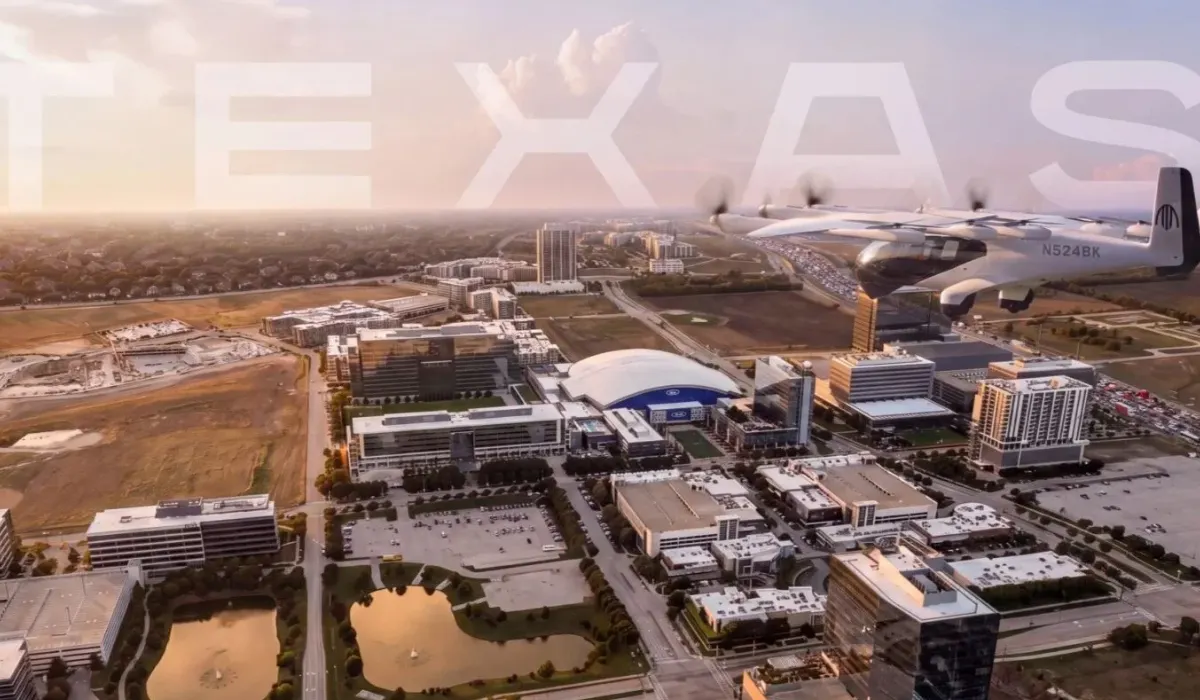
Key Points
- US electric aircraft manufacturer Archer Aviation has announced plans to establish urban air taxi networks across Austin, Dallas-Fort Worth, and Houston.
- The proposed aerial transit networks focus on the ‘Texas Triangle’, a high-growth megaregion connecting urban hubs inhabited by over 20 million residents.
- Using its flagship all-electric Midnight eVTOL aircraft, Archer aims to convert 60-to-90-minute ground drives into 10-to-20-minute flights.
- The initial route maps heavily prioritize connections between regional commercial airports, general aviation facilities, and key business districts.
- US Senator Ted Cruz welcomed the announcement, stating that the project will reinforce American leadership in the skies and allow Texans to reclaim commuting time.
- Through America’s Consortium for Electric Skyways (ACES), Archer is collaborating with Beta Technologies, Macquarie Capital, and the Texas Department of Transportation to build out charging infrastructure.
Texas (Texas 24 News) October 26, 2026 — American electric aircraft manufacturer Archer Aviation has formally unveiled operational plans to deploy urban air taxi networks across three of Texas’s largest metropolitan hubs. The proposed regional networks will span the ‘Texas Triangle’, targeting major population centers in Dallas-Fort Worth, Houston, and Austin. Operating its piloted, four-passenger all-electric vertical takeoff and landing (eVTOL) Midnight aircraft, Archer intends to bypass severe highway congestion by offering short-haul aerial routes. The initial route proposals focus heavily on connecting commercial and general aviation airports directly to key suburban business parks, downtown helipads, and coastal destinations. The initiative has received official endorsements from state and federal political leadership as infrastructure planning advances alongside regional transportation authorities.
- Key Points
- What Are the Key Details of Archer’s Planned Air Taxi Networks in Texas?
- How Have Political and Business Leaders Responded to the Announcement?
- What Infrastructure Challenges and Downtown Vertiport Questions Remain?
- Background of the Particular Development
- How This Development Can Affect Texas Commuters and the Transportation Sector
What Are the Key Details of Archer’s Planned Air Taxi Networks in Texas?
As reported by technology editor Ciaran Daly of IoT Tech News, US electric aircraft developer Archer Aviation has outlined strategic plans to establish commercial air taxi networks across Austin, Dallas-Fort Worth, and Houston. The expansive proposals target the ‘Texas Triangle’, an economic megaregion connecting several of the state’s largest urban centers that collectively house more than 20 million residents.
According to technical documentation released by Archer Aviation, the company’s objective is to offer Texans a direct method to “skip over traffic” by utilizing its Midnight eVTOL aircraft. The manufacturer projects that the all-electric platform will convert traditional 60-to-90-minute automotive commutes into 10-to-20-minute aerial flights.
As observed by Ciaran Daly of IoT Tech News, the published network maps indicate that Archer is prioritizing air taxi routes between regional airports and high-value commercial centers. The planned network layout differs across the three metropolitan areas:
- Dallas-Fort Worth: Represents the most extensive proposal to date, aiming to link multiple aviation hubs—including Dallas-Fort Worth International Airport, Dallas Love Field, Addison Airport, Arlington Municipal Airport, Fort Worth Meacham International Airport, and Perot Field Fort Worth Alliance Airport—with major commercial centers, currently anchored by Frisco Station, a 242-acre mixed-use business development in northern Dallas.
- Houston: Plans to connect George Bush Intercontinental Airport, William P. Hobby Airport, and Sugar Land Regional Airport with the Thompson Hotel Helipad in downtown Houston. The proposed framework also establishes a direct aerial connection between downtown Houston and the coastal city of Galveston, a corridor that typically requires over an hour to traverse by motor vehicle.
- Austin: Details remain comparatively limited, with Archer stating that the network will connect key facilities, including Austin-Bergstrom International Airport and Austin Executive Airport, to notable destinations across the capital region, such as the Circuit of The Americas helipad.
How Have Political and Business Leaders Responded to the Announcement?
As reported by aviation journalist Chris Katje of Benzinga, Archer’s proposed expansion into Texas has drawn strong support from federal and state political figures who view the technology as a key economic driver.
US Senator Ted Cruz explicitly praised the initiative, framing the deployment of electric air taxis as a vital step for national competitiveness in advanced aerospace. As reported by Chris Katje of Benzinga, Senator Ted Cruz stated: “The race to dominate next-generation aviation is moving faster than ever. Archer Aviation is a prime example of American innovation, demonstrating that the United States has what it takes to be the global standard. These three planned networks will not only allow Texans to reclaim their time but also strengthen American leadership in the skies”.
Local business groups and economic development boards across the Texas Triangle have similarly welcomed the announcements, noting that high-speed point-to-point transit could alleviate severe pressures on interstate highway corridors that have struggled to keep pace with rapid population growth.
What Infrastructure Challenges and Downtown Vertiport Questions Remain?
As highlighted in the analysis by Ciaran Daly of IoT Tech News, the current network proposals raise operational questions regarding urban accessibility. Based on the published maps, Archer’s initial routes focus primarily on existing general aviation and commercial airports. To date, only one designated ‘downtown’ station has been confirmed in Houston (the Thompson Hotel Helipad) and one in the Dallas area, while no central urban vertiport site has yet been listed for Austin.
Industry analysts noted that relying heavily on existing airport facilities could present logistical hurdles for daily commuters attempting to avoid highway traffic, as passengers would still require ground transportation to reach final downtown destinations.
However, as reported by Ciaran Daly of IoT Tech News, Archer previously announced its involvement in America’s Consortium for Electric Skyways (ACES) in July. Formed alongside Beta Technologies and Macquarie Capital, ACES aims to electrify up to 250 potential air taxi landing sites across the United States. Archer is actively collaborating with the Texas Department of Transportation (TxDOT) and regional municipal partners to install high-powered aviation charging systems across the state, a move anticipated to facilitate the opening of additional urban and downtown vertiport locations over time.
Background of the Particular Development
Archer Aviation’s expansion into Texas represents a major milestone in the broader commercialization of electric vertical takeoff and landing (eVTOL) aircraft in North America. Headquartered in Santa Clara, California, Archer has spent years developing its flagship Midnight aircraft, a piloted, four-passenger, zero-operating-emission aircraft engineered for rapid back-to-back short-haul trips. Texas represents the fifth major market for which Archer has published detailed network route maps, following initial announcements targeting the San Francisco Bay Area, New York City, South Florida, and Los Angeles.
The regulatory framework surrounding advanced air mobility (AAM) in the United States has progressed significantly under federal oversight. The Federal Aviation Administration (FAA) has been establishing airworthiness certification criteria and operational rules to safely integrate eVTOL aircraft into controlled national airspace alongside commercial air traffic.
Texas has positioned itself as an attractive proving ground for advanced aviation due to its favorable regulatory environment, supportive state leadership, and the geographic reality of the Texas Triangle. With major urban centers separated by dense highway corridors subject to heavy traffic congestion, the region presents an ideal commercial environment for short-range aerial transit.
How This Development Can Affect Texas Commuters and the Transportation Sector
The deployment of Archer’s Midnight air taxi networks across Austin, Dallas-Fort Worth, and Houston is set to introduce structural changes for daily business travelers, municipal urban planners, and the broader regional transportation ecosystem.
Impact on Business Travelers and Daily Commuters
For corporate executives, frequent flyers, and regional commuters within the Texas Triangle, the establishment of functional air taxi routes offers a dramatic reduction in transit times. By turning 90-minute highway drives into 10-to-20-minute flights, professionals traveling between regional airports and suburban business parks—such as Frisco Station or downtown Houston—can avoid unpredictable traffic delays. While initial ticket pricing is expected to target corporate and premium travelers, scaling operations and expanding vertiport access could eventually make aerial transit a viable option for a broader commuter demographic.
Operational Implications for Municipalities and Airport Authorities
For city planners, transit agencies, and airport operators across Texas, integrating eVTOL infrastructure will require substantial municipal coordination. Local governments will need to update zoning ordinances, establish noise contour guidelines, and process building permits for vertiport charging facilities. Furthermore, airport authorities will need to manage airspace integration to ensure that low-altitude air taxis can operate safely alongside traditional commercial jet traffic without causing ground pad or runway bottlenecks.
Influence on the Advanced Air Mobility Market and Energy Grid
From an industry perspective, the success of Archer’s ACES consortium in establishing charging infrastructure across Texas will serve as a crucial benchmark for the global eVTOL sector. The deployment of high-capacity electrical chargers at regional airports and urban helipads will place new demands on local utility grids, driving investments in localized power distribution and renewable energy integration. If successful, the Texas network will establish a replicable commercial template for regional air mobility across major metropolitan areas worldwide.