
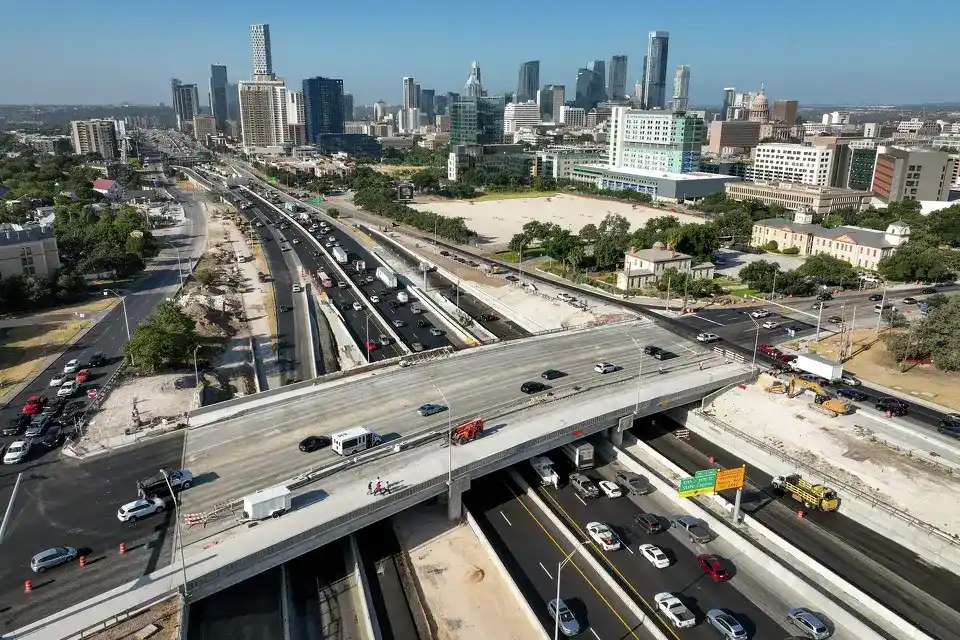
- Central and Downtown I-35 Ranks Seventh Statewide: An annual congestion report from the Texas Department of Transportation (TxDOT) and the Texas A&M Transportation Institute (TTI) ranked Interstate 35 through central and downtown Austin—between U.S. 290 North and Texas 71—as the No. 7 most congested roadway segment in Texas based on 2025 traffic data, making it the worst bottleneck in Central Texas.
- Year-on-Year Rise Despite Improvement Since 2024: The nearly 8-mile stretch of I-35 became more congested year-on-year, climbing two places from No. 9 in the 2025 report, though it remains better than in the 2024 edition when it ranked third statewide.
- Eleven Austin Metro Segments in Statewide Top 100: Of the 100 most congested roadway segments identified across Texas in the 2026 annual report, 11 were located in the Austin metropolitan area, including two additional South Austin I-35 segments—between Texas 71 and Slaughter Lane (ranked second in Central Texas and 19th statewide) and between Slaughter Lane and Texas 45 (ranked third regionally and 30th statewide).
- Statewide Delay Eases While Construction Continues Through 2033: While overall Texas roadway congestion eased in recent years—with TxDOT and TTI data showing drivers lost 11% less time to traffic delays in 2025 than in 2017 despite 13% higher travel, saving roughly $1.6 billion—TxDOT’s I-35 Capital Express Central widening project is expected to continue through at least 2033.
Texas (Texas 24 News) November 26, 2026 – Interstate 35 through central and downtown Austin ranked No. 7 among Texas’ 100 most congested roadways in the latest annual report from the Texas Department of Transportation and the Texas A&M Transportation Institute. Reported across Texas transportation coverage and the 2026 TxDOT–TTI annual report (alongside reporting by Tessa Cho of Little Elm), the study found 11 Austin-area segments on the list even as statewide delays eased.
- How Did Interstate 35 in Central and South Austin Rank in the New Congestion Report?
- How Does Austin’s Congestion Compare With Broader Statewide Trends in the TxDOT Report?
- How Do Austin’s Top Interstate 35 Congestion Segments Compare?
- Background of the Particular Development After the News
- How This Development Can Affect Austin Commuters, Freight Operators and City Planners
Texas roadway congestion has eased in recent years, according to a new annual report from the Texas Department of Transportation (TxDOT) and the Texas A&M Transportation Institute (TTI) (cited alongside statewide coverage by Tessa Cho of Little Elm on 19 November 2026), though the state’s most congested stretches—including several in Central Texas—are getting worse.
The annual report from TxDOT and the Texas A&M Transportation Institute identified the state’s 100 most congested roadway segments using 2025 traffic data. Eleven of those segments were located in the Austin metropolitan area, with one ranking inside the statewide top 10.
How Did Interstate 35 in Central and South Austin Rank in the New Congestion Report?
Reporting on the TxDOT and Texas A&M Transportation Institute annual report sets out the rankings and year-on-year shifts across Austin’s Interstate 35 corridor:
- Central and Downtown I-35 Moves Up to No. 7: Interstate 35 through central and downtown Austin ranked as the most congested stretch in Central Texas, according to the TxDOT and TTI report. That nearly 8-mile segment, running between U.S. 290 North and Texas 71 (Ben White Boulevard), ranked No. 7 for overall congestion statewide. That section of highway became more congested year-on-year, moving up two spots from No. 9 in the 2025 report, although it has improved since the 2024 report, when it ranked third.
- South Austin I-35 Segments Rank 19th and 30th Statewide: To the south, the 4-mile portion of Interstate 35 between Texas 71 and Slaughter Lane was identified as the second-most-congested roadway segment in the Central Texas region, and the stretch from Slaughter Lane to Texas 45 ranked third regionally. Across Texas as a whole, those two South Austin I-35 segments ranked 19th and 30th, respectively.
- Ongoing I-35 Capital Express Central Construction: TxDOT is widening the freeway in an effort to alleviate congestion along the corridor. The I-35 Capital Express Central project is expected to continue through at least 2033.
How Does Austin’s Congestion Compare With Broader Statewide Trends in the TxDOT Report?
Additional findings from the 2026 Texas Top 100 Congested Road Segments Annual Report by TxDOT and the Texas A&M Transportation Institute—as reported by Tessa Cho of Little Elm on 19 November 2026—provide wider context across Texas:
- Statewide Delay Reduction and Commuter Savings Since 2017: According to the 2026 TxDOT and TTI report (as reported by Tessa Cho of Little Elm on 19 November 2026), Texas drivers lost 11% less time to traffic delays in 2025 than in 2017—described by TxDOT as a recent high point for congestion—even though overall travel rose 13% over the same period. TxDOT estimated that the drop in delay saved commuters approximately $1.6 billion in lost time and fuel in 2025 compared with 2017, or roughly $235 per commuter for the year.
- Where Other Austin Projects Saw Relief: While central I-35 climbed two spots to No. 7, the report noted improvements where major Austin highway upgrades have progressed: at the U.S. 290 and State Highway 71 interchange project at Oak Hill, partial completion reduced delay by 40%, dropping that segment from No. 45 to No. 79 on the statewide list. Across all 100 segments in the 2026 report, every entry was located in the Dallas–Fort Worth, Houston, San Antonio or Austin metropolitan areas.
How Do Austin’s Top Interstate 35 Congestion Segments Compare?
A structured summary compiles the Austin Interstate 35 rankings and statewide benchmarks from the TxDOT and Texas A&M Transportation Institute report:
| Roadway Segment / Metric | Regional & Statewide Rank | Key Details & Trends | Source / Attribution |
| I-35 (U.S. 290 North to Texas 71) | No. 1 in Central Texas; No. 7 statewide | Nearly 8-mile central/downtown stretch; worsened from No. 9 in the 2025 report, though improved from No. 3 in the 2024 report; I-35 Capital Express Central widening runs through at least 2033 | TxDOT & Texas A&M Transportation Institute Annual Report |
| I-35 (Texas 71 to Slaughter Lane) | No. 2 in Central Texas; No. 19 statewide | 4-mile South Austin corridor segment identified among the 11 Austin-area entries in the Top 100 | TxDOT & Texas A&M Transportation Institute Annual Report |
| I-35 (Slaughter Lane to Texas 45) | No. 3 in Central Texas; No. 30 statewide | South Austin segment connecting Slaughter Lane and SH 45 among the 11 Austin-area entries | TxDOT & Texas A&M Transportation Institute Annual Report |
| Statewide Congestion & Oak Hill Project | 11 Austin metro segments in Top 100 | Statewide delay down 11% in 2025 vs. 2017 despite 13% travel growth ($1.6bn / ~$235 per commuter saved); U.S. 290/SH 71 at Oak Hill fell from No. 45 to No. 79 (-40% delay) | TxDOT & TTI 2026 Report; Tessa Cho of Little Elm |
Background of the Particular Development After the News
Since 2009, following a mandate from the Texas Legislature, the Texas Department of Transportation has partnered annually with the Texas A&M Transportation Institute to evaluate over 2,100 road segments across more than 11,000 miles of state highways and rank Texas’ 100 most congested roadways using person-hours of delay per mile and truck delay per mile.
In Central Texas, Interstate 35 serves as both the primary local north–south commuter artery through Austin and a major international freight corridor, leading TxDOT to launch the multi-billion-dollar I-35 Capital Express programme to add non-tolled managed lanes and reconstruct interchanges through central, north and south Austin.
How This Development Can Affect Austin Commuters, Freight Operators and City Planners
Continued top-10 congestion on central Interstate 35 alongside multi-year highway reconstruction carries practical implications across several groups:
1. Daily Austin Commuters and Local Residents
For drivers commuting along I-35 between U.S. 290 North, downtown Austin, Slaughter Lane and Texas 45, active construction on the I-35 Capital Express Central project through at least 2033 means lane shifts, overnight closures and bottleneck delays are likely to persist before long-term capacity relief is realised.
2. Commercial Freight and Logistics Operators
For trucking companies and regional supply-chain operators relying on the central I-35 corridor—which also ranks among Texas’ most congested freight routes—rising year-on-year delay between U.S. 290 North and Texas 71 increases schedule variability and fuel costs.
3. Transportation Planners and Regional Transit Agencies
For TxDOT engineers, the Capital Area Metropolitan Planning Organization and local transit providers, the contrast between worsening central I-35 rankings and the 40% delay drop at the partially completed U.S. 290/SH 71 Oak Hill interchange reinforces reliance on corridor-widening investments and alternative arterial or transit routes.