
- Academic Medical Centre and Medical School Expansion: The University of Texas (UT) is building out a new academic medical centre and expanding its medical school infrastructure in Austin—including the planned UT Dell Medical Center and UT Dell Campus for Advanced Research—to bolster the regional economy.
- Support for Two Emerging Economic Sectors: The healthcare buildout is expected to strengthen Austin’s economy by supporting two emerging regional economic sectors alongside growing job creation, physician recruitment and commercial development across Central Texas.
- Major Philanthropic and Institutional Backing: Reporting from The Texas Tribune (Stephen Simpson), Community Impact (Ben Thompson), American School & University (Robert Nieminen) and Becker’s Hospital Review (Giles Bruce and Kelly Gooch) documents how Michael and Susan Dell’s $750 million investment in April 2026—pushing their total giving to UT Austin past $1 billion—is helping launch the AI-enabled UT Dell Medical Center, targeted to open in 2030 alongside integrated University of Texas MD Anderson Cancer Center oncology services.
- Medical Training and Workforce Pipeline: Dell Medical School—which currently enrols around 200 active students and nearly 500 residents or fellows, and has graduated more than 300 physicians since 2020 with nearly half remaining in Texas for residencies—stands to expand enrolment, residency programmes and clinical training capacity as the new academic health system develops.
Texas (Texas 24 News) November 26, 2026 – The University of Texas’ buildout of a new academic medical centre and medical school expansion is set to boost Austin’s economy by bringing more jobs, doctors and development to the region while supporting two emerging economic sectors. Documented across regional reporting by Community Impact, The Texas Tribune, Becker’s Hospital Review and American School & University, the multi-billion-dollar healthcare push centres on the planned UT Dell Medical Center and UT Dell Campus for Advanced Research.
- How Will the University of Texas’ Healthcare Expansion Bolster Austin’s Economy?
- What Role Do Medical Education and Clinical Training Play in the Expansion?
- How Do the Key Projects and Figures in UT Austin’s Healthcare Expansion Compare?
- Background of the Particular Development After the News
- How This Development Can Affect Austin’s Economy, Residents and Healthcare Workforce
The University of Texas building out a new academic medical centre and a medical school is expected to bolster Austin’s economy by supporting two emerging economic sectors in the region, bringing more jobs, doctors and development to Central Texas.
How Will the University of Texas’ Healthcare Expansion Bolster Austin’s Economy?
Reporting from regional and healthcare publications—including Ben Thompson of Community Impact, Stephen Simpson of The Texas Tribune, Giles Bruce and Kelly Gooch of Becker’s Hospital Review, and Robert Nieminen of American School & University—outlines the scale and economic scope of the University of Texas at Austin’s healthcare buildout:
- Jobs, Physician Recruitment and Regional Development: As set out in the Austin healthcare report, the University of Texas’ investment in building a new academic medical centre and advancing its medical school infrastructure is projected to stimulate local economic growth by attracting physicians, generating healthcare and research employment, and spurring development across two emerging economic sectors in the Austin region.
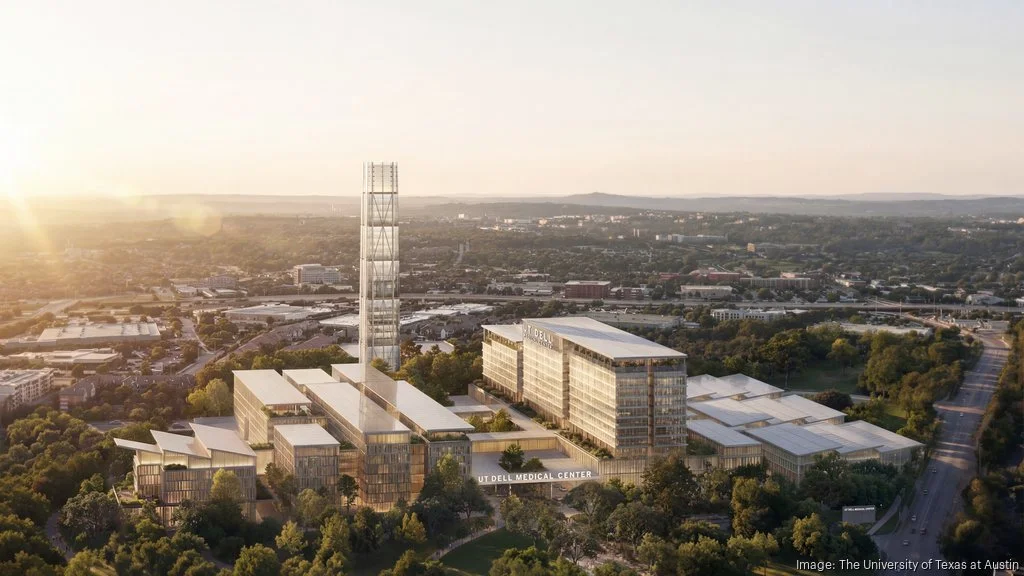
- The UT Dell Medical Center and Advanced Research Campus: As reported by Stephen Simpson of The Texas Tribune on 21 April 2026 and Robert Nieminen of American School & University on 20 August 2026, Michael and Susan Dell committed $750 million in new investments in April 2026—making them the University of Texas at Austin’s first $1 billion donors—to help launch the UT Dell Campus for Advanced Research and the AI-enabled UT Dell Medical Center in North Austin off MoPac, designed by architectural firm Skidmore, Owings & Merrill and scheduled to break ground in 2026 ahead of a planned 2030 opening.
- Integration of Oncology, AI and Academic Medicine: As reported by Giles Bruce and Kelly Gooch of Becker’s Hospital Review on 27 October 2026, UT Austin rebranded UT Health Austin as UT Dell Medicine ahead of developing the $5 billion AI-native academic medical centre, which will also integrate the University of Texas MD Anderson Cancer Center to deliver specialised cancer care, clinical research and computing-driven healthcare in Austin.
What Role Do Medical Education and Clinical Training Play in the Expansion?
Coverage by Ben Thompson of Community Impact on 1 July 2026 details how the academic medical centre connects directly to medical school enrolment and physician retention in Texas:
- Expanding Dell Medical School Enrolment and Residencies: As reported by Ben Thompson of Community Impact on 1 July 2026, the UT Dell Medical Center—part of the 300-plus-acre UT Dell Campus for Advanced Research—is designed to expand capacity as Dell Medical School grows from its base of roughly 200 active medical students and nearly 500 residents or fellows. Since 2020, Dell Medical School has graduated more than 300 doctors, with nearly half remaining in Texas for their residencies.
- Statement on Clinical Training Environment: As reported by Ben Thompson of Community Impact on 1 July 2026, Dell Medical School Dean Claudia Lucchinetti stated: “Creating a hospital for the 21st century with those capabilities built in provides an environment for not only our doctors and our nurses and our care team, but for our students and our residents to be actually learning in the environment they are practicing in”. Addressing the broader clinical mission, Claudia Lucchinetti added: “We are committed to … changing the model of care delivery, and hope to become a model of health for the nation”.
How Do the Key Projects and Figures in UT Austin’s Healthcare Expansion Compare?
A structured summary compiles the core components, timelines and figures reported across the sources:
| Component or Metric | Reported Detail | Source / Attribution |
| Core Economic Objective | Buildout of a new academic medical centre and medical school infrastructure to bring jobs, doctors and development while supporting two emerging economic sectors in Austin | Austin Healthcare Expansion Report |
| UT Dell Medical Center & Research Campus | AI-enabled academic medical centre and 300-plus-acre UT Dell Campus for Advanced Research off MoPac in North Austin; groundbreaking planned in 2026 and opening targeted for 2030 | Ben Thompson of Community Impact; Robert Nieminen of American School & University |
| Philanthropic & Capital Scale | $750 million gift from Michael and Susan Dell in April 2026 (surpassing $1 billion in cumulative UT Austin giving) toward the $5 billion AI-native hospital initiative and broader $10 billion 10-year fundraising goal | Stephen Simpson of The Texas Tribune; Giles Bruce & Kelly Gooch of Becker’s Hospital Review; Robert Nieminen of American School & University |
| Medical School & Specialty Care | Dell Medical School (~200 active students, ~500 residents/fellows, 300+ graduates since 2020) paired with integrated UT MD Anderson Cancer Center oncology care under UT Dell Medicine | Ben Thompson of Community Impact; Giles Bruce & Kelly Gooch of Becker’s Hospital Review |
Background of the Particular Development After the News
Historically, Austin was one of the largest metropolitan areas in the United States without a comprehensive academic medical centre of its own until the establishment of Dell Medical School at the University of Texas at Austin in the 2010s, which graduated its inaugural class in 2020.
In August 2023, the University of Texas System announced a major initiative to combine UT Austin’s computational strengths with UT MD Anderson Cancer Center’s clinical oncology expertise in Austin—a plan accelerated in 2026 through Michael and Susan Dell’s landmark $750 million donation and the formation of the UT Dell Medicine academic health system.
How This Development Can Affect Austin’s Economy, Residents and Healthcare Workforce
The University of Texas’ buildout of an academic medical centre and expanded medical school capacity carries practical implications across several groups:
1. Austin’s Regional Economy and Emerging Industry Sectors
For Central Texas businesses, real estate developers and research enterprises, sustained capital investment in medical facilities and life-sciences infrastructure is expected to diversify Austin’s technology-heavy economy by anchoring two emerging healthcare and biomedical sectors.
2. Physicians, Medical Students and Healthcare Workers
For doctors, nurses, medical students and clinical researchers, expanded residency slots, larger medical school cohorts and integrated oncology and AI-supported clinical facilities will create new training and employment pathways in Austin rather than requiring specialists to relocate to Houston or Dallas.
3. Central Texas Patients and Residents
For residents across Austin and surrounding counties, local access to academic subspecialty care—including integrated MD Anderson cancer treatment—will reduce the need to travel outside Central Texas for complex medical procedures.